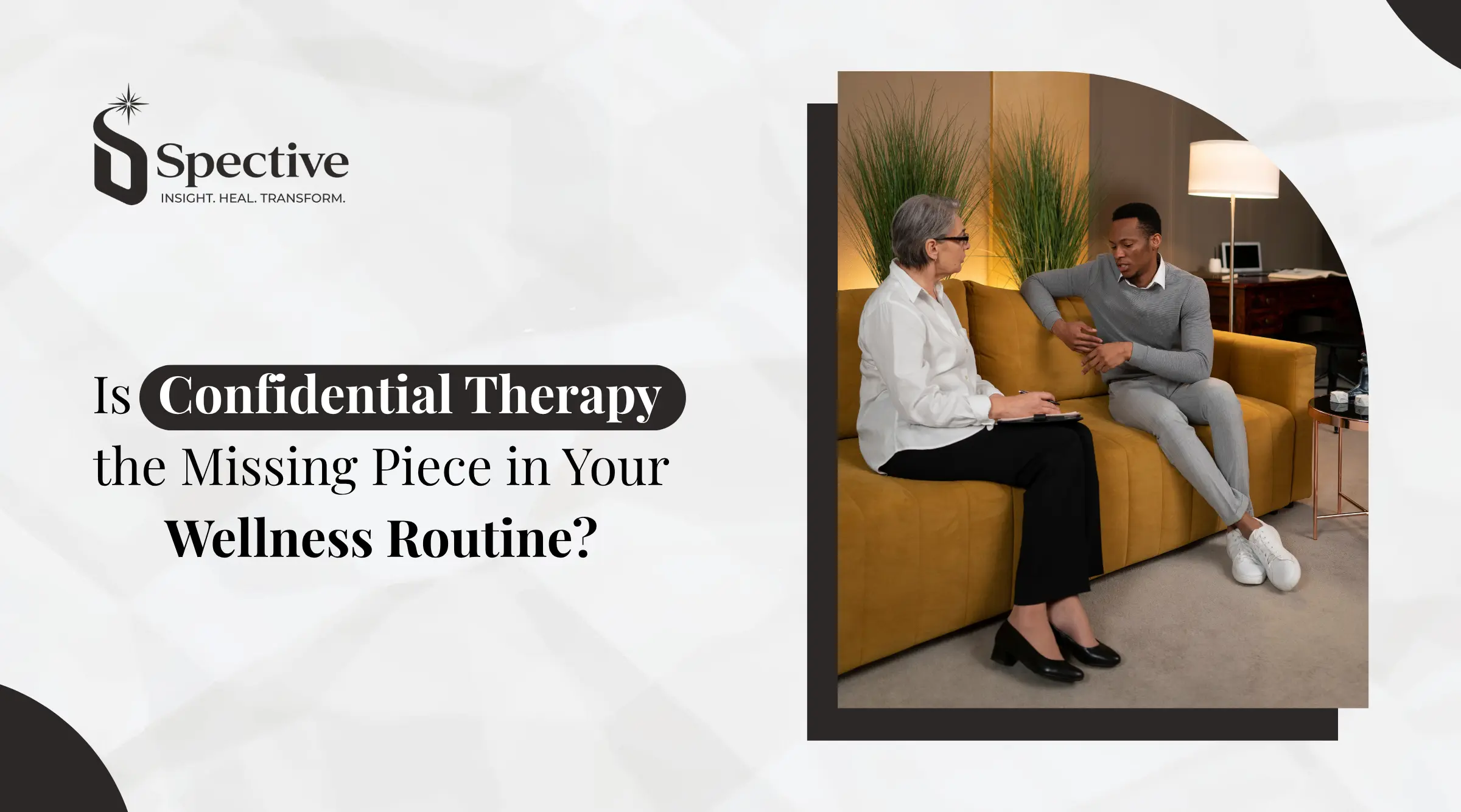
You eat well, exercise and sleep enough, yet something still feels off. Confidential individual therapy provides private, one-on-one support to help you understand your emotions, build resilience and grow.
At Spective Health, these dedicated sessions prove you do not need a crisis to make therapy a regular part of staying well.
Why Might Your Wellness Routine Have a Quiet Gap?
Most wellness routines focus on the body. Walking, weightlifting, or sleep tracking are permitted. One can write in a journal or practice meditation. These are good habits. They promote your well-being and help you manage the stress you will face in your day-to-day life.
But self-care has limits. It is not designed to treat deep-rooted patterns or serious mental health concerns. Self-care helps you maintain. Therapy allows you to resolve and comprehend what self-care can’t solve.
Therapy is not just for bad times. Experts describe therapy as a lifelong wellness tool. It can support you to connect to your values, build meaning and live with intention. Those appointments are similar to the physical check-up you might get at the doctor’s office.
What Makes Confidential Individual Therapy Different
Not all therapy is the same. Confidential individual therapy is personal, individualized and confidential. Here’s what makes it special.
Privacy Builds Trust
Privacy is not just a rule. It is a clinical tool. A national survey of United States adults published in the American Journal of Geriatric Psychiatry found that 87.3% felt comfortable discussing their mental health, confirming that privacy and comfort are crucial to mental health care.
If you trust that your words stay private, you share more honestly. It aids your therapist in understanding you more quickly and assisting you better.
Trust is another benefit of confidentiality. Patients report that confidence in confidentiality helps them open up and go deeper in their work.
One-on-One Focus
In individual therapy, you get your therapist’s full attention. The pace and plan are created for you. You can discuss a very private subject without a group of people hearing you. This privacy may make it easier to discuss trauma, relationships, and personal fears.
Legal and Ethical Protection
Professionals should keep your information confidential and have a duty to ensure that it is. According to HIPAA rules, psychotherapy notes are protected documents. Most of the time, your therapist has to ask you first for permission to share them.
How Confidential Therapy Fits into a Wellness Routine
Therapy does not replace your healthy habits. It works with them. One counselor compares therapy to training for the brain. Just as you strengthen your muscles at the gym, you can strengthen your mental strength in therapy.
Here is how confidential therapy can support the rest of your wellness routine:
- Emotional resilience
You learn to handle stress without falling apart
- Self-awareness
You see your patterns and make different choices
- Better relationships
You communicate more clearly and set healthy limits
- Stress management
You build practical skills for hard days
- Personal growth
You move toward the life you actually want
You don’t need weekly sessions forever. The most important thing is to make treatment a regular practice, even if it looks different at different stages in your life.
Signs Confidential Therapy Could Be Your Missing Piece
You don’t need a diagnosis to start. Consider therapy if:
- The same problems keep coming back
- Self-care helps for a while, but the weight returns
- You feel trapped and unsure about what to do
- You are in a significant transition, a move, a loss, or in a new role
- You seek to know more about yourself and develop yourself
- You are tired of carrying something alone
When self-care is not sufficient, professional help provides something a bubble bath and a journal don’t.
What to Expect in a Confidential Individual Therapy Session
Your first session is a conversation. You will talk about what brought you in and what you hope to change. Your therapist will explain how confidentiality works and its rare legal limits. You will ask questions. You will set goals together.
At Spective Health, confidential individual therapy is designed to support emotional insight, resilience, clarity and lasting personal growth. Each session is private and built around your needs.
Your sessions can give you time to explore concerns at your own pace. You can talk through challenges, look at your choices and work toward changes that matter to you.
FAQs
Is therapy really private?
Yes. Therapists are bound by law and ethics to protect your information. There are rare exceptions, such as immediate risk of harm to you or others. Your therapist will discuss these boundaries before you start.
Do I need a diagnosis to start therapy?
No. Therapy for personal growth, stress and prevention is used by many. You don’t need to be unwell to benefit.
Can confidential therapy replace self-care?
No. They are best suited to working in pairs. Self-care is a way to keep yourself healthy. Therapy helps you understand and change deeper patterns.
Take the Next Step toward a Complete Wellness Routine
Your wellness routine already includes your body. Now it can include your mind. At Spective Health, confidential individual therapy is a space for private one-on-one sessions where emotional insight, resilience, clarity and enduring growth are fostered in a supportive environment.
You don’t have to wait for a crisis to take care of your mental health. Book your appointment for a private evaluation now and discover a complete wellness experience!